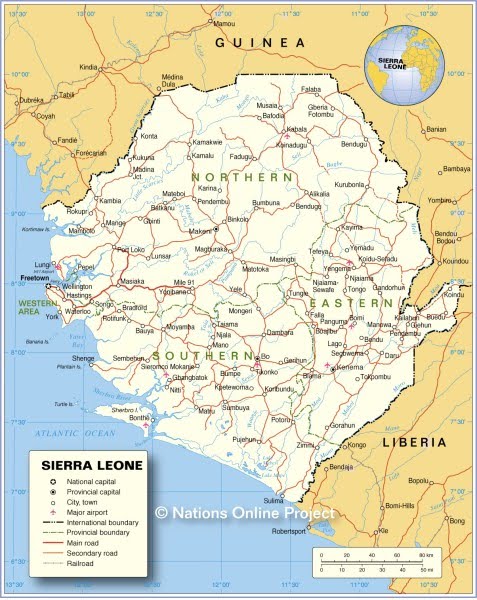
Map of Sierra Leone

Map of Sierra Leone

Sunday, August 22, 2010

The Three Rs: Ridin, Raitin and Riligohn

Many years ago, we listened to the first hand experience of Inderjit Bhogal, who on entering a book shop would regularly ask “Where are the black writers?”. Inderjit is a Ugandan born British Asian, who grew up in a Sikh household and as a young man became not only a Christian, but also a Methodist minister. He had just completed his year of office as the Methodist Church in Britain’s first black president when he told us of his shopping experience. In a store that sold books and stationery, a sales assistant was clearly puzzled by Inderjit’s question and proceeded to display the variety of black felt tipped pens that were available.
Who are black writers? African writers? religious writers? These are questions with many facets. They have been interpreted differently throughout history, and the various eras of socio-political and literary change have shaped their development. Reading, writing and religion are complex issues.

Graham Greene, the British author, prepared the novel, The Heart of the Matter, when he was based in Sierra Leone and working for the Secret Intelligence Service during World War II. Set in Salone, the story is not just about failure, but about the price we all pay for our individualism and the impossibility of truly understanding another person. As in many of Greene's earlier works the story deals with not just the tension of the individual and the state, but also the conflict of the individual and the church. Greene was apparently annoyed by being referred to as a Catholic novelist, insisting that as a novelist he was also a Roman Catholic.

In an another era, Thomas Mofolo, from Lesotho, had already
written a novel, The Fallen Angel before 1925, when he produced the work for which he is best known, Chaka, based on the life of the legendary Zulu, King Shaka. The book is considered one of earliest literary expressions of African Theology, and by a lay theologian. It is highly likely that Steve Biko, as the leader of the Black Consciousness Movement in South Africa would have been aware and influenced by the writings of Thomas Mofolo, when in the late 1960’s Biko produced a collection of his own writings under the title I write what I like.

The Salonean writer, Olufemi Terry, said " I write what I like to read", shortly after receiving the 2010 Caine Prize (the African Booker ) for short stories. His award winning story, “Stick fighting days”, is based on ritualised combat conducted by young boys, who inhale solvents to comatose themselves against poverty in Nairobi. As with numerous other acknowledgments of artistic and literary accomplishments, the award ceremony for this African achievement, was held in Europe, in the Bodelian library in Oxford, England. The shortlist for the prize also included, How shall we kill the Bishop? by the Kenyan Lily Mabura, whose quizzical title explores the nature of religious life for members of a catholic community, endeavouring to serve God during the country’s transition towards independence. Both Terry and Mabura’s stories display features to be found in the highly acclaimed book Say you’re one of them by Uwem Akpan, a Nigerian Jesuit priest, whose short stories are not for those who want a romanticised notion of childhood in Africa .

In Freetown, the most available novel by an African writer, is that of the Nigerian, Chinua Achebe’s first novel Things fall apart, which was published in 1958. It is the story of a traditional village "big man" Okonkwo, and his downfall. The book has been translated into some 50 languages but not Krio, and as a secondary school text in Salone, it is for sale in photocopied editions on numerous stalls on Freetown’s streets. Other than the bible, there is very little literature available in Krio. It is not surprising then, that those entering the world of literacy want to be able to read and write in English. Bank forms, medical prescriptions and children’s schoolwork are all in English. Preparation for literacy classes are now underway for some 60 or more potential adult learners, following the training of fourteen adult literacy facilitators. It is not I write what I like, but I read what I need to know. Entering the world of literacy, for this particular group, who are HIV+, will enable them to do more than sign their name. Literacy safeguards their health, wellbeing and their finances against possible exploitation. Becoming literate empowers a person to not only rid and rait but to have access to the writings of their riligohn.

Sunday, August 15, 2010

For Better, for Worse, for Richer, for...

Our visitors, be they visiting Salone for the first time or returning to the country, provide us with insights into where we are and the people with whom we are living. Newcomers ask penetrating question on what they encounter and want to know why “this and that” does or does not happen. Whilst those who are re-visiting, produce fascinating illustrations on historical events and ‘life as it was then’, they often provide introductions to a network of people who shape church and society.

Recently, former mission partner Ken Todd initiated a visit to see Mary Musa, a stately figure who would, had it not been for ill health, been the current Vice President of the Methodist Church in Sierra Leone (MCSL). In an animated conversation, which included stories which took place nearly 40 years ago, she spoke of her family and referred to several of her grandchildren now living in the United States, courtesy of the ‘DV’ system. The ‘DV’ meant nothing to us until a week later, when a friend spoke of her hopes that the ‘DV’, would provide a passage out of Salone into a future of promise and opportunity. It emerged that a ‘cousin’ within her family had won the ‘DV’ lottery and was entitled to take his spouse with him and so she was intending to become that person, which would, of course, entail marrying him. The Diversity Visa system of the United States government, offers approximately 50, 000 people per annum, from around the world, that same opportunity. It would appear that of the few Saloneans who succeed in the DV lottery, it is extremely rare for them to arrive in the USA unmarried. In Salonean society, the ‘DV’ offers security for more than just the lucky individual, so that marriage and potential procreation become the means of ensuring wellbeing and prosperity for each of the families involved.

Just over 2OO years ago John Lemon, a Bengali hairdresser, won a similar lottery, but in reverse. At the time he was the headman of the ‘Black Poor’ in London, whose occupational experiences had included assisting slave trading in Freetown. A decade later, in 1808, he was back in Freetown having ‘won’ a place on the Vernon, where he married Elizabeth, who was, as one historian described “one of the original prostitute wives”, of which there were many. Together, Mr and Mrs Lemon joined the other 2,000 inhabitants of Freetown and Elizabeth became a shopkeeper who, following John’s death would have had little difficulty in re-marrying as men vastly outnumbered women in the ever increasing colony.

Today in Sierra Leone, three forms of marriage are accepted by the State: customary marriage, which is often polygamous; civil marriage; and also religious marriage, which if conducted within the Islamic faith may also be polygamous. With the Christian Church being a minority faith, (the United States’ CIA’s statistics claims it to be only 10% of the population), it is not surprising that monogamous marriage is a matter of some concern for those who are committed to growth in church membership. Many of the prospective members of the Church are either Muslims or practice African traditional religion. With the exception of some African Initiated Churches, Christian churches are doctrinally committed to monogamous marriage.

In many African societies, the nature of marriage, be it monogamous or polygamous, is not the primary concern of the human relationship between a man and a woman, as it is the birth of children which constitutes the purpose of marriage. The Catholic theologian, Benejet Bujo, argues that no issue in African ethics has been more disputed (at such length and often vehemently) than that of the morality of marriage, especially in relation to polygamy. As a Ugandan celibate priest, he writes on ‘the problem of monogamy’, and its challenge to the African church’s authenticity. However, mindful also of the process of rapid urbanisation across the continent, he asks if polygamy “is compatible in modern Africa with the dignity of women”.

Another Catholic theologian, Laurent Mpongo, of the Democratic Republic of the Congo, raises a question that is pertinent in West Africa too, involving the relationship between customary marriage and that of the church. The MCSL requires its ministers who have been married by customary or civil marriage, to have their marriage blessed in church, as “the church’s way of ensuring by means of a special form of service, that her members acknowledge the Christian concept of marriage and vow to live by it”. There are some, including Mpongo, who would be very critical of the Church’s inability to acknowledge the strength of authentic African culture in customary marriage.

Despite the work of those mentioned above, there appears to be no serious theological reflection on the role of marriage in society generally and its place in the church specifically, in West Africa and especially in Salone. It could be easily argued that people in a fragile country are all too aware of their own socio-political vulnerability to address questions on marriage, especially where religious affiliation is a feature of the tension between polygamy and monogamy. This tension is exemplified in the Western Area of the country, which includes Freetown. It is here where Krios form the largest ethnic group and are monogamous. This contrasts significantly with the Provinces, where other ethnic groups are in the majority. Such a demographic detail is not to be ignored when addressing the theological development of African Christianity in Sierra Leone. It may also be a good enough reason to look elsewhere on the continent of Africa for a debate on an integrated Christian spirituality, where people live their way to a new understanding of marital relationships within the church.

However, the pastoral implications of ignoring the question of what kinds of marriage are appropriate within the membership of the Salonean church, may lead to an attitude of secrecy and complicity as opposed to transparency and integrity. It is the task of church leaders to reflect on which of these would be for better, or worse.

Thursday, July 22, 2010

FIFA, Famine, Food and Forests

It is less than a week since the climax of the FIFA World Cup, when, for month, it appeared there was only one story in Africa to be reported on. Our household is uneven in its love of the game dedscribed by one writer as the provider of “the coinage on human discourse” across the whole of Africa.

Before the continent’s biggest ever sports story began to unfold a friend, who knows a little of Africa, sent us a book, “Africa United – How football explains Africa”. And in many ways it does, at least with numerous stories of joy and celebration, conflict and war, international and national political manipulation, as well as of the transcendental power of a game in the midst of poverty, famine, piracy and opulence in a few of the sixty nations that are ‘Africa’.

25 years ago a single story began to emerge from the Horn of Africa, which may have contributed to the notion that there is only one story for the whole continent. It was the famine of Ethiopia, the result of successive harvest failures, coupled with unresponsive superpowers, immersed in the “Cold War Story”. All these impacted on the need for humanitarian aid, to avert the impact of ‘climatic genocide’ upon millions of people.

As the details the famine of Niger and Chad become increasingly evident, the question as to why it is happening and how it could have been prevented will be re-visited. However it is highly unlikely that it will be the prime story from the continent unless there is a journalist of the calibre of Michael Buerk, working for a large media corporation, or a rock star as big as Bob Geldof, to raise the profile of the disaster and demand that the world take note and act with its cash and food!

Thankfully the catastrophe in the Gulf of Mexico may no longer be the threat it was, but there’s still too much truth in what Leon Uris wrote fifty years ago, in his book, Exodus. “Only the Kingdom of heaven runs on righteousness... The kingdoms of the earth run on oil”. The BP oil spillage has been headline news for the last three months, with reference to billions of dollars. Chad and Niger have rarely featured, and the amount of money needed to feed hungry people is significantly less.

Sierra Leone is now into the rains, the time that is referred to as the hungry season. Crops are planted during this time, to be harvest during the dry season. Last year’s harvest has now finished. Subsistence agriculture depends on rainfall and sunshine and timing of both. If the rains start too early, or finish too late, the nation’s harvest will be affected. For the subsistence farmer the balance of both rain and sun is vital, and neither can be plugged, capped or tapped.

Niger and neighbouring Chad, already among the poorest nations in the world, are at the centre of a food crisis affecting 10 million people in the Sahel region. The average age for Nigers and Chadians is 15.2 years and 16.6 years respectively. Figures last month showed that over one in five children were already facing acute malnutrition in the worst-hit regions. These same children are already the food producers for their societies. It is increasingly apparent that the human cost of last year’s failed rains in the Sahel belt could be as high as they were in 2005, when TV images of starving children shook the world out of its inertia, but it was too late to address the worst of the crisis. An appeal for an increase in the World Food Programme’s aid for Niger and Chad to US$253 million from US$191 million has so far had little impact, with only 58 percent of the required figure having been provided, leaving a shortfall of US$107 million.

In Sierra Leone, where the average age of the entire population is 19 years, the war children of the previous decade are now the fathers and mothers of their own children, and the education process that was severely disrupted, or denied to young parents is still evident. A nation’s informal agricultural education is never assisted by the internal displacement of hundreds of thousands of its citizens and unfortunately the need to establish an adequate income forces people to harvest the rainforest. The demand for hardwood timber by the oil rich Gulf States and beyond, has resulted in the growth of both the legal and illegal logging industries. It is therefore encouraging to see that the government’s initiative to ban the export of logs last year, has now been extended for a further three years. Logging for processing and for the domestic markets of fuel, furniture and the building industry are not affected, but the short term economic solution of raising cash from logging will have been seriously deterred.

It is unclear if FIFA’s proposed new goal line technology will involve posts of timber or not. Throughout Salone the soccer goalposts are usually constructed of stout lengths of bamboo. There is an abundant supply of bamboo and huge stands of this versatile crop are often located alongside the nation’s largest and thriving oil industry, the palm oil. But that is another story of food for a later date.

Wednesday, July 14, 2010

“Ah tel God tehnki”.

Towards the end of the rebel war ECOMOC soldiers had been brought into Sierra Leone, to try to bring some form of law and order to the country. Like any intervention in a country such groups need to be housed and fed. Freetown already had army barracks at Wilberforce, and so it was to this place that the troops were located. Extra buildings were needed and constructed. “Wilberforce Barracks” is now an residential area of low cost housing in Freetown, and not just the place where troops live. ECOMOC troops left a number of years ago, and some of the former barrack buildings provide housing for many families looking for a place of shelter. We walked through an area of the original barracks with Doran, a nurse from the Methodist Church Sierra Leone - People Living with HIV and AIDS project, to make a home visit to one of their clients who is living with the HIVirus. Hawa, the mother of the family, had been contacted, to ask if she would be willing for Peter and I to visit her. MCSL is very careful in the way that they conduct the home visits, as often the neighbours are not aware of the status of the person they are visiting. This was the case with Hawa. A mother of four boys, all of them HIV positive, she had moved into the room of a house, as her husband had abandoned her, once he knew her status, even though, he himself is also positive. We went into the dark room, made of mud blocks, with a concrete floor, measuring 12’ x 8’. It had a zinc roof, but the rain-filled sky above could be seen through the holes, made from the nail holes when used on a previous building. The only protection for the window was chicken mesh. A piece of foam, covered with sheets, was on the floor. There was just one chair to sit on. Hawa and her four children share this space with a 5 more people.

Confidentiality was just one of the big issues of the conversation. She did not want her neighbours to know her status because of the possibility of being homeless again. All of them are taking antiretroviral drugs, but they are kept in a friend’s house who is also HIV+. The medication is given at 5am in the morning before the rest of the room is awake, so they do not know what is happening. Taking the medication on an empty stomach is not a good idea, and she spoke of her children sleeping a lot. The youngest child was sick, and needed to go the hospital for medication. At least this is now provided free. The three other boys were on holiday from school, but did not know their end of year results as the teachers were demanding almost £1 per child in order to give the results. The teachers have to find another way of supplementing their income, especially if they have not been paid.

Like many other women, Hawa discovered her status from blood tests done at the ante natal clinic. All pregnant women who attend ante natal clinics are tested, given counselling, and prescribed free drugs. She spoke of the father of the children. He too had been tested and is positive. But it is Hawa who is seen as bringing the sickness into the home. He now has another “wife” who is pregnant.Hawa shared with us her own health problems, and that she has been bleeding most of the time for 4 months, but did not have the money to pay for the medication. Hopefully this problem will be resolved in the next couple of days.

MCSL had helped Hawa , with the provision of a home kit which includes a bucket, blankets, and toiletries as well as food, and she spoke in great detail of how this had made a difference to the life of her family. She also highlighted how the fortnightly visits of the volunteers gave her encouragement, and removed the feeling of isolation. Before we left we prayed with the family, and the most common phrase spoken during the time together was “Ah tel God tehnki”.

We then moved to another part of Wilberforce Barracks where we visit Selia, who was recovering well, having been in hospital for two weeks. Feeling strong and eating well, she too said over and over again. “Ah tel God tehnki”. Like Hawa, she had discovered her status through the ante natal clinic, but unfortunately both her children had died. Her husband had left her, but friends had been encouraging him to return, that she needed his support and encouragement. He had not been tested for the virus. Her living conditions were slightly better than those of Hawa, and had friends that she could talk to. Her father knew of her status and though angry at first came to realise that his daughter needed him, and so had started to show more help. We prayed with her and left with the same words echoing -“ Ah tel God tehnki”.

We then drove much closer to the centre of Freetown, and not far from the college where we both teach. We went to visit Teresa, living in a room of the first floor. She had been seriously ill, three years ago, could not see, hear, or walk. Taken into hospital her blood was tested for the virus. Her daughter, 25 years at the time, was with her when she was given the news. She is the only member of the family who knows her status. Teresa’s husband works in the police, and says he has been tested negative. He knows Teresa is taking medication, but she says it is for sickle cell anaemia, which is common in Sierra Leone. We talked about safe sex, when just one partner is positive, and she said that they use condoms as they do not want to have any more children. She has developed some intriguing strategies to hide her status.

I had met Teresa at the monthly meetings in Wellington, and so there was an exchange of humour, when we went in, as I had taught the group the action song, “ Head , shoulders, knees and toes”. Laughing, Teresa told us how, if clients from the clinic meet each other in the street, they touch their head and shoulders as a greeting! Teresa hopes to be at the meeting on the third Friday in the month. Again we left with the words “Ah tel God tehnki”.

All the conversations we had were in Krio. Peter and I do not need literacy classes but we need to learn how to communicate in Krio. The empowerment of such women as Hawa, Selia and Teresa, through becoming literate and numerate, can make another difference to their lives. A group of people from MCSL, living positive lives, are to be trained at the end of July, to make this possible. They will then go on to teach their friends.

The Methodist Church Sierra Leone - People Living with HIV and AIDS project has over 300 clients on its books. Home visits are made to 46 of them, who live in various parts of Freetown. The commitment of the full time nurses is tireless, often not taking their annual entitlement to holiday leave. There is a team of volunteers, counsellors and social workers who work with the nurses, all of them HIV positive, present themselves as positive, optimistic people. For all of them, and organisations like Christian Aid that provides some of the funding for this vital project “ Ah tel God tehnki”.

Note. The training of Adult Literacy Facilitators will take place 19-30 July. Classes for the women who attend the monthly meetings will proceed, subject to funds being available. If you can find time to pray for this, “Ah tel God tehnki”

Saturday, July 10, 2010

“Wata, Wata, Plastik, Plastik”

The collapse of the Nile Basin Initiative talks concerning the waters of the Nile River, has reminded me of just how problematic such conversations can be, even when there are only two countries involved and there are no complicated colonial treaties. Whilst we were working in Porto in the mid 1990s, a 3 day Iberian Summit was held in the same city but despite both Spain and Portugal’s concern on the issue of water, it was thought the subject was too divisive to be placed on the agenda. The numerous major river systems that cross Portugal, including the Douro and the Tejo, all rise in neighbouring Spain, seen at that time, as removing an excessive amount of water before it reached Portuguese territory.

Five East African countries have recently announced their refusal to go back on a deal they signed last month to share the waters of the Nile, despite fierce criticism from Egypt and Sudan. Egypt is of course almost totally dependent on the waters of the Nile and, in addition to the threat of climate change, is also watching the construction of a hydroelectric dams in East Africa. Meanwhile Ethiopia, Uganda, Tanzania, Rwanda and Kenya proceeded with the signing of an agreement in May, without the participation of their northern neighbours. The Nile Water Treaty, signed in 1929, is perceived as unjust, having been agreed during a period of colonial rule. Two other nations, Burundi and the Democratic Republic of the Congo, have yet to sign the deal and have so far refused to say whether they plan to so or not.

The weather in Freetown this past week has demonstrated just how wet the next few months are likely to be, with the capital only recently receiving the heavy rainfalls that most of Salone has been experiencing for several weeks. One exceptionally heavy thunderstorm coincided with the announcement that more than 50 water companies have responded to the government’s requirement for certification and licensing from the Pharmacy Board of Sierra Leone for the selling of sachets of water. This is in response to a number of companies being found to be selling contaminated water. Supplies of piped water into the city are controlled by the Goma Valley Water Company from a reservoir in the nearby hills. However the infrastructure of the operation was designed in the 1960s for the capital’s 400,000 people and today greater Freetown has more than three times that number of inhabitants.

Thirsty people require drinkable water wherever they are and that includes when on the city’s streets as well as in their homes, which generally have no piped water supply. The demand for this most precious of all liquids, results in huge quantities of water being sold in polythene bags that hold half a litre of “treated” water, which unlike Goma Valley water, is considered drinkable. It is not difficult to imagine what happens to discarded polythene bags as they are dispensed with by pedestrian and households alike. Polythene bags quickly provide an impenetrable dam in storm water drains and result in flooding where it is least wanted, with the water packets that do escape the street gutters invariably end up in the sea and on neighbouring beaches.

A degree in environmental science is not required to conclude that water distribution in Freetown is an ongoing disaster in search of catastrophe. So when we heard of the Trashy Bag project from two USA mission partners who were in Ghana recently, we were all ears and cameras. (see www.trashybags.org). The ingenious recycling of 90 polythene bags and sewing them into an attractive and sturdy shopping bag is a huge initiative and provides employment for 150 people and offers a potential, if small, solution to the discarded water packet problem. In Freetown a packet of water costs approximately 5p, but at 10p a litre that is great deal of money to individuals and impoverished communities who consequently have to resort to drinking water without the security of knowing its quality, so that typhoid and other water borne diseases are far too prevalent.

At a time when Salone and Freetown enjoys a more than generous rainfall the problems of the Nile Basin nations can seem far removed from daily living but the issues of water are always multi-dimensional be to the north or the south of the Sahara.

Tuesday, July 6, 2010

Tiwai island


The well established ecotourism facility and wildlife sanctuary of Tiwai Island is one of several tropical rainforest islands on the Moa River in the south east of Sierra Leone. Local communities in the area are benefiting from visits by tourists and researchers to provide an income and support the needs of their communities. Since the end of the war, The Environment Foundation for Africa (EFA), with the aim of creating a protected area suitable for biodiversity research, conservation and ecotourism, has worked in convincing local communities that farming, hunting and logging are the not the only ways of prospering from the island.


Arriving on the island by boat you are led to a camp in an opening in the forest which comprises of a main central open-sided building, shower and toilet block and peripheral sleeping areas.


The central building holds information on the island and has dining facilities and is where you are debriefed. Around the edge of the camp there are currently three sleeping areas which consist of a concrete base with tents (without fly sheet) and mattresses under a wooden frame with corrugated iron roof. We soon discovered on the first night that this configuration works extremely well as we were totally protected from the heavy downpour. Extra accommodation in the form of wooden chalets in pockets of the forest which will offer a more luxurious stay are also being built. The facilities on the island are basic but the on-site cook provides good meals of local produce normally consisting of the typical rice, fish and nut stew. Drinks can be bought on island but it is still worthwhile bringing some provisions with you.

Activities on offer include guided walks, boat excursions on the river and spending time on a beach which unfortunately is only worth visiting during the dry season. Visitors can follow guided trails but in order to venture further a field we opted for a morning and evening guided walk as you are more likely to see the various species of monkeys and other wildlife at those times of day. There are several guides who take it in turns to show people around the island and whose knowledge of the grid system of tracks is invaluable. The tracks are designated by letters or numbers that after a while you would get to know but as we were only there for a short period of time its worth leaving the navigation to the guide.


Walking through the cool undergrowth of redwoods, thick vines, large crops of bamboo and smell of formic acid and stopping while the guide provides information of the flora and fauna or points out a group of monkeys you would have either walked passed or easily disturbed without realising they were there. Our guide also pointed out the significance of certain types of tree. The cotton tree is one significant example.


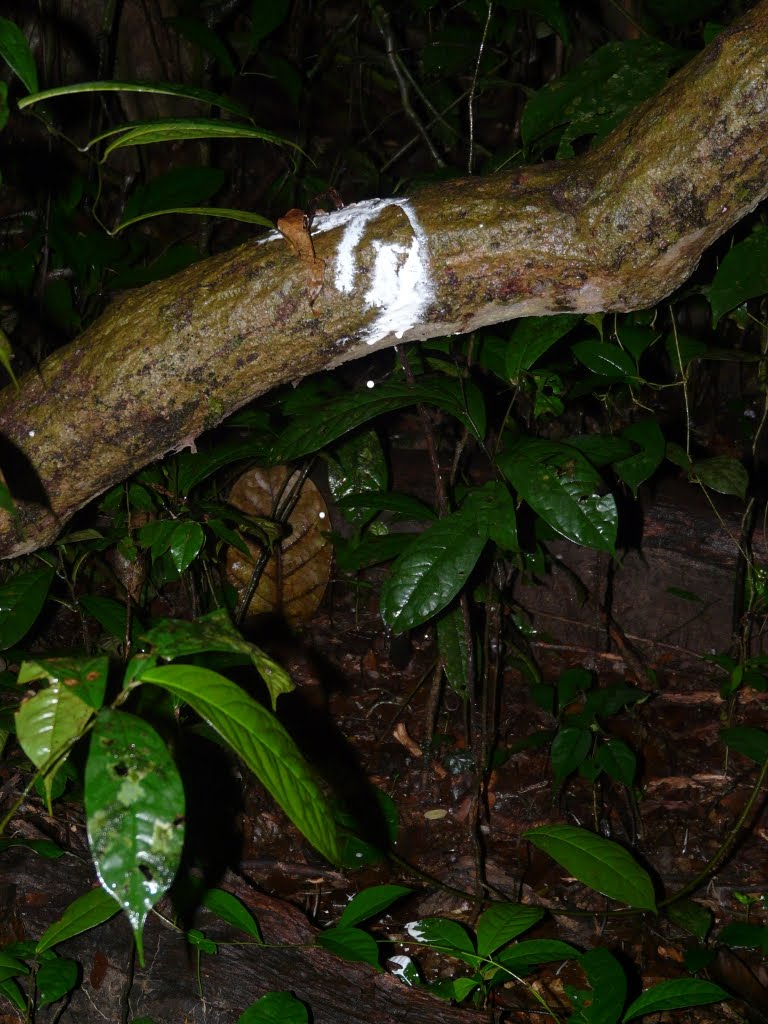
It is highly respected as it is considered to be sacred and that the closest and largest one to a village should not be chopped down, to for example, make a dugout. A striking example of this same symbolism can be seen in the old part of Freetown where a cotton tree provides a roost for thousands of bats most evenings. In traditional medicine, the seeds, leaves, bark and resin are used to treat dysentery, fevers, venereal diseases, asthma, menstruation and kidney diseases. Definitely a tree worth looking after. Another tree with more relevant symbolism in the west and visually impactive after being cut into was the latex tree.


Our guide was very helpful and informative and keen to provide us with the best chance of seeing and learning about whatever we came across, pointing out duiker droppings, monkey footprints and mimicing calls of certain monkeys. The duration of the walks were a lot longer than advertised but as we were so engrossed in the search for the different species of monkeys, chimpanzee being the most sought, we just kept on looking. One major benefit of the early morning walk is the temperature you experience under the protection of the canopy and relief from what would be energy sapping heat.


The most elusive creature in the area is the pygmy hippo. It is a solitary nocturnal animal only found in Liberia, Ivory Coast and Sierra Leone. Its behaviour is currently being researched on Tiwai by an American lady who has only seen it three times in the flesh and uses motion trigger cameras to track the animals and glean potential information. Previous attempts to capture and tag these animals have proved unsuccessful as two animals ended up in a holding pen resulting in one killing the other. They are also so elusive that even when a BBC wildlife visited the island to film the they were unable to get any footage.

Amongst the various species of butterflies, spiders and vegetation the highlights of what we saw include western black and white colobus monkey, lesser spot-nosed monkey, diane monkey, red colobus monkey and olive colobus monkey.


We also saw several species of the six varieties of hornbill found there who’s call and noise of their wings flapping above the canopy were very distinct. The experience of wandering the forest, enjoying its sights and sounds and getting away from the hustle and bustle of Freetown is definitely worth the trip!


Wednesday, June 30, 2010

Seeing a need…

Never before have I arrived in a country and upon entering the immigration hall been ushered directly into the VIP Lounge, effectively bypassing the expectant immigration officers. But this is what happens when Janice and Peter are also expecting your arrival in Sierra Leone!

My 8-day stay with Janice and Peter seemed a fitting culmination of my time in Edinburgh as it immediately preceded the start of my own 3-month training period as a mission partner with the Methodist Church. In time I will be serving in Fiji, thousands of miles away in the south Pacific, and quite distant from Sierra Leone in many respects, not just in terms of mileage.

My visit to this particular part of west Africa was a catch-up time with my hospitable hosts but it was also an excellent opportunity to see seasoned mission partners in-situ and ‘in action’. Inevitably Janice and Peter had arranged a full programme.

What follows are only a few of the many examples of projects and support groups that I was shown, where people, having seen a need, were responding whole-heartedly and in a positive and timely (sometimes far-sighted) way for the good of local communities. All the ventures aimed to provide participants with relevant skills and newfound confidence in their own self-worth.


HIV-AIDS Support Group, Wellington: I was fortunate to co-incide my visit with the once-a-month meeting of the HIV-AIDS support group, held in the nearby town of Wellington. Around 120 people were in attendance, drawn from both the Christian and Muslim communities of the wider Freetown area. The group had been in existence for some time, and Hawa, the project manager, took great delight in accounting how the group had visibly gelled and gained in confidence as a community over that time.


In recent months, Janice has been busy co-ordinating a two-week long adult-literacy programme to train suitably educated group members as teachers. The vast majority of attendees at the HIV-AIDS support group are not able to read and write and each month sign for travel expenses with a thumb print. The adult literacy training programme will be held during the latter half of July and letters offering a potential trainee placement on the programme were handed out at the meeting to those deemed suitably qualified. Recipients of these letters proudly read and re-read them, and stated that their potential acceptance on the course was ‘very good news’ indeed.

While Janice had secured money for the training programme, the ensuing three-year adult-literacy teaching programme still requires financial support. Unfortunately, while I was there, we heard that they had been unsuccessful in obtaining funding from Feed the Minds for the teaching stage. Janice, having ‘seen the need’, is determined to follow-up other funding opportunities.

Let’s pray that the necessary funding will be secured.


MC Women’s Skills Development Centre, Freetown: Freetown is the home of the women’s training and skills project of the MCSL. Over a two-year period, young women are trained in the art of gara (tie-dying) and taught other needle-craft skills. They are also given access to basic education. Our visit co-incided with a group of 15-year olds just completing their First Year exams. On the classroom board was information related to that day’s lesson: the methods of transmitting the HIV-AIDS virus.

Elizabeth, the co-ordinator, showed the types of products the girls made (bedspreads, table clothes, aprons etc.), and explained that when they arrived the girls often had behavioural problems, though she said that that ‘was to be expected’. The group we encountered were impeccably well behaved, though a little shy at having their photo taken.

The need for a Women’s Development Centre in Freetown is on-going, and the project continues to expand; across from our classroom, the walls of a new classroom were nearing completion.

Let’s pray for the successful expansion of the Centre’s facilities.

Craftshare Technical Vocational Centre, Bo: Craftshare is located on the outskirts of Bo, Sierra Leone’s second city. Rev. Patrick, the head of the Centre, showed us around the site in the pouring rain. The timetable in the staff room gave an indication of the subjects taught: numeracy; literacy; masonry practical and theory; carpentry theory and practical; business management; tailoring (cutting and sewing); designing; cloth weaving; soap making; counselling (HIV-AIDS) and catering. Unfortunately, our visit was too early in the morning for us to sample the bread rolls from their newly-constructed bakery.


Instead we were shown inside each of the classrooms. Most of the rooms were self-explanatory, though owing to the rain, some of them were being used as temporary dry stores for the Centre’s newly-produced bricks. Student numbers were fewer that morning than usual because of the difficulty in accessing the Centre in the wet weather. When we were shown the cloth weaving room only one lone student was skilfully working the loom; it had to be pointed out to us that she was blind.
It was still raining when we left the Centre, forcing us to hurriedly tip-toe our way around deep, muddy potholes to our car. At that moment another blind student arrived on-foot and unaccompanied. He was drenched to the skin and must have walked unaided a considerable distance, somehow negotiating the atrocious road conditions to get to his class.

Let’s pray for the continued commitment of both Craftshare staff and students.

Seeing a need… Julia Edwards