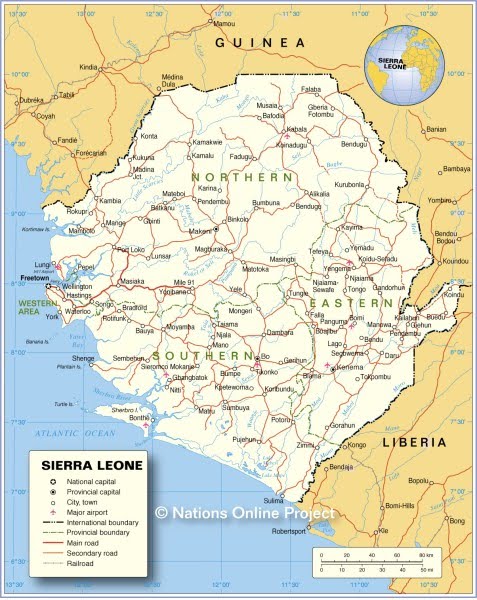
Map of Sierra Leone

Map of Sierra Leone

Monday, February 7, 2011

Hominoids Together - Shared Experiences of Captivity and Freedom

Only few miles from the centre of Freetown, the Western Area Forest Reserve, a tropical rain forest covers towering mountains, gives space to a sanctuary, conceived as a response to human oppression and cruelty. A short distance from the forest reserve, savannah covers another part of the same mountain range, and is dotted with small communities, whose heritage is also a testimony to an inglorious piece of human history, the transatlantic slave trade. In being able to visit both communities within a few hours, it is difficult to avoid asking the question, why have we been and continue to be, so stupid? There may be no simple answer but thankfully there are a small number of people involved in the task of addressing our stupid behaviour.

The genesis of the Tacaguma Chimpanzee Sanctuary lies
in the simple act of Bala and Sharmila Amarasekavan rescuing a chimpanzee from captivity some 150 miles north of Freetown. At the time, 1988, it was thought there were only 2,000 chimpanzees in Sierra Leone. That each one of them could live for more than six decades and would become five times as strong as its captor, did not stop people from imagining that a primate which could be imprisoned as a pet!

The life of Charlotte village was conceived in 1807, when, due in no small measure to the Clapham Sect, it became possible for the British navy to intercept foreign slave ships and rescue their cargo. At the time, it was not known that the transatlantic slave trade had involved in excess of ten million people being taken captive along the west coast of Africa, and that history would be forever trying to comprehend such human barbarity.

There are close on one hundred chimpanzees in residence at Tacaguma Chimpanzee Sanctuary, where, since 1995, they have been cared for in their own age-based social groupings. Each chimp is called by its original name, which reflects their Russian, Belgian, French American or British captor’s choice of names. Each of the four groups, of approximately 25 chimps, are housed in the type of habitat that provides for rearing, socialization and independence in preparation for their release, when and where appropriate. The exact location is kept secret, but thanks to the work of the sanctuary, its trans African network of conservation groups, and newly enforced legislation, it is now estimated that there are 5,500 chimpanzees in Sierra Leone.

Krio villages including Charlotte, Gloucester and Bathurst, were established early in the 19th century as vibrant communities consisting of liberated slaves who built schools and introduced small scale farming, and where Quakers and Anglican influence was well represented. The early influence of the Church Missionary Society in governmental decisions, which shaped the ‘Province of Freedom' at the time, continues in the life of St John’s Church, Charlotte, today and where the parish priest, Rev Prince Leigh is keen to share the history of the church and community. Prince, a graduate of the college where we work, stresses how demographic changes, natural disasters and the civil war have reduced the population of the Charlotte village to less than sixty people, one fifth of what it once was. However he speaks with pride on how a threat to the church’s existence was overcome, when the National Power Authority, began to insist that the siting of a high voltage pylon would require the demolition of the church building. The pylon was erected and the church continues to stand but the village still has no electricity!

The enthusiasm and dedication of the sanctuary staff is exemplified by Willie Tucker, who gained an international scholarship and trained in conservation work in East Africa before returning to work with the sanctuary for the last two decades. Like Prince he knows from personal experience the effects of war and the actions of sobels (soldier turned rebels) who are violent and hungry. The physical and psychological damage inflicted upon both the entire Tacugama chimpanzee community and Charlotte villagers is very similar. The similarity of trauma caused to both types of residents underlines more than just the sharing of 98.6% of DNA between humans and chimpanzees. Sanctuary staff are keen to explain that their work in protecting species largely threatened by hunters of ‘cheap bush meat’, represents but a “tip of the iceberg”, in the challenges faced in protecting Sierra Leone’s natural habitat. The educational work of environmental sensitisation conducted by the sanctuary is a vital part of that process. Resilience is also a shared feature of our DNA.

Simple questions about our human stupidity are relatively easy to ask. The answers are rather harder to find. The opportunity to stand on a raised tower in the sanctuary and view the forest and its habitat, or to gaze at the drama of Charlotte waterfall even in the dry season are invitations to contemplate the bigger questions, not just of the past but of future.

We do not need to be located in the tropical rain forests of a country emerging from civil war, to be able to identify our failures and mistakes of the recent past. It is likely that wherever we are we too live in the midst of imbalances of good and evil.

In searching for appropriate wisdom, the thoughts of contemplative masters are helpful. Thomas Merton, in recognising that we are often captive to self acquired attachments, offers his thought on freedom and liberty:

“The mere ability to choose between good and evil is the lowest form of freedom” ... “Freedom is not an equal balance between good and evil choices but in the perfect love and acceptance of what is really good and the perfect hatred and rejection of what is evil.

Saturday, January 15, 2011

Moments from Movies and Mosques in Morocco

Arriving home from Morocco to stories of ‘no light’ for the previous 10 days and only a meagre supply of water on one or two of them, is the perfect way to be bumped back into Freetonian reality. The practical technology shock demands an immediate concentration upon a daily, survival strategy and not a culturally rich holiday itinerary in North Africa.

Morocco was great. It was a reminder of what West Africa is and is not. However, some of the strongest and persistent features of our impressions were not one of ‘why can’t Saloneans have consistent power and drinkable water?’ but just how frequently we were connected with experiences of the Iberian penninsula and in particular our time in Portugal. Despite having an awareness of how much the Moors and the Arabic language had contributed to the collection, distribution and supply of water in Portuguese homes, we were still not prepared for the socio- cultural similarities. These were more evident among the men, especially those seated outside cafes, than the women, but also the school aged children, both boys and girls, wore what might be called a white ‘laboratory coats’ to attend classes, as they did two decades ago in Portugal. Beautiful, decorative tilework, known as “azulejo” in Portuguese, was to be found inside and outside, public and private buildings.

Religious differences between Islam and Christianity reversed some features of daily life. In Porto, we were accustomed to seeing women entering into the local Catholic Church throughout the day, but especially in the morning and late afternoon. In Morocco of course, it was the men whose devotional adherence was most evident with frequent attendance at prayers in one of the many mosques located in the vicinity. Each day around 6am, whilst lying comfortably in bed and enjoying the stillness, it was not difficult to hear at least four separate calls to prayer, all within the same neighbourhood. Personal questions were even more numerous. How do the men choose in which direction they will move as they leave home? Is geography, parental allegiance or the theology of a mosque the determining factor? How is attendance at prayers affected by the generational differences? And why did many mosques indicate they were only open to Muslims visitors?

From our limited stay in Morocco it was clearly evident that interfaith relationships are different from what we encounter in Freetown. Not only were the mosques of Casabalanca, Marrakesh, Essaouira and elsewhere, invariably closed to non-muslims but the evidence of Sufi spirituality in music, dance and the participation of women in them was also evident too. Morocco is profoundly Islamic, and whilst it had a large Jewish population in the 19th and 20th century (there was as many 250,000 before the founding of Israel 1948) there are less that 25,000 today and only 1% of the 34 million inhabitants are Christian. It was not easy to find either synagogues or churches but we did. We found that the three large churches in three separate locations were all very different, historically and in expression of faith and devotion. But each of them, like the synagogues, had a strong police presence at their gates, but were,nevertheless, clearly marked on town and city maps.

The name Foucauld also appears on many of the same maps. The French priest and hermit Charles de Foucauld spent time in both Algeria and Morocco and understandably his contribution to Catholic spirituality was well recognised in the 19th Century by colonial French culture and municipal planners. Foucauld’s time in the region was a concentrated effort to discover an authentic discipleship, which eventually led to being ordained a priest in Europe. He later installed himself in a hermitage Ben Abbess in the Sahara Desert on the Algerian side of the Moroccan border. His motivation was simple. It was to seek out the poorest and most abandoned people, and serve them. “I wish to proclaim the Gospel with my life” he said; so, not by preaching or administering the sacraments, like conventional missionaries, but by his very way of being. He wanted to be Christ in the midst of people who did not know Him. To achieve this he had intended to establishment a religious community in Morocco.

With reliable stories of as many as twenty Christian being deported in the year 2010 from Casablanca alone, for alleged evangelism or proselytising, it is hard to see how anything other than mere maintenance of a personal Christian identity would be permitted today. Despite the reforms of King Mohammed VI whose Presidential powers are extensive, the country’s main opposition political party has an Islamist agenda which is keen to challenge any indication of religious pluralism in the populace of Morocco. So, what would living as a Christian in Morocco require today and what would or could be a viable, personal and public identity? It was a question we carried home with us, and were quickly reminded of how the question changes with context. As we arrived at the gate to our compound, on the last day of the year, at 6.30am, we met the street-walking, megaphone-using evangelist, who was passing by. Throughout the year, on numerous mornings we have heard the distorted proclamations, without ever comprehending what he said. We discovered that he was simply compelling his listeners, who like us were greeting a new day, to give thanks to God and attend prayers in their nearest church.

We began our visit to Morocco in Casablanca and left from there too. In Michael Curtiz’s film of the same name, there are numerous people arriving in the city. They each possess one of many identities, including being a refugee, but they have only one destination, Lisbon, with neutral Portugal being the gateway to North America for people fleeing the Third Reich. The years 1940 to 1941 were a tense time for the un-occupied French territories, which included the cities of Casablanca, Algiers and Tunis. Recent weeks have seen a sharp rise of socio-political unrest in the latter and as we complete this blog, there are reports of a state of emergency in Tunisia. Morocco and Algeria also face almost identical problems, that of rising food prices, persistently high unemployment (especially among university graduates) and a desire for greater reform. It may be that even wider political changes in the region are imminent.

Today’s cities of Casablanca, Rabat, Algiers or Tunis, are all seen by the European Union as buffer zones in south to north migration including from Sub Saharan Africa. The strengthening of fortress Europe against it neighbours in the south continues in numerous ways, expressing its desire to seal itself off from the forces of internationalism. The legacy and global popularity of the film Casablanca is as great as ever, with its multi-dimensional appeal, one of which may be its hugely multi-cultural cast and of its 22 speaking roles, only 3 of them are filled by Americans. And the director Curtiz, was an Hungarian Jew.

Hollywood, where, in fact, the film Casablanca was shot, is not the destination of choice for those Africans seeking to head north. What they do seek is an environment that offers greater opportunities, and where each will have space to realise their aspirations, and express their own identity.

Thursday, December 16, 2010

The African Big C.

At the end of long, hot day, our car was well loaded with a mixture of colleagues and students. Despite the heat and the hour, the banter was flowing in Krio and English with laughter in both. We were approaching the time for examinations and tension around a number of issues emerged frequently and humour served as a release from the tensions. From a student who is also a senior school administrator we heard a story from a previous decade and of the malpractice of a teacher who ensured that students, who should not have been able to sit for an examination, found with a little payment that there was a place available on the day that mattered . Suddenly the flood gates opened on the stories of corruption... “Did you see that story on the 80 million Leones that has gone missing from the Anti Corruption Commission?” The carload laughed in chorus and further corruption anecdotes flowed faster than the traffic. 80 million Leones is £120,000, a huge sum of money in a country where the largest denomination 10,000 Leones, is only the equivalent of 2US$, a day’s pay for a 12 hour shift on building site.

In teaching a course on Christian Leadership and Church Management, Peter finds when addressing the formation of conscience and its influence on decision making, the students are over eager to provide evidence of the existence of corruption and struggle to concentrate on its causes. It is as though their experience of injustice, accumulated during the civil war, in society and in the church, is so acute that they need to unload their anger and frustrations, before addressing any analytical thinking as to what creates corruption.

The correlation between income per capita and corruption generally indicates that those nations with the lowest levels of economic inequality perform higher in the international transparency league and demonstrate a lower level of corruption. Recently the BBC world service has chosen to explore the existence of corruption by highlighting two countries at opposite ends of the spectrum, Sweden and Somalia. In doing so, they have highlighted another aspect of cause and effect, that of war and civil conflict. Sweden is nation without a history of war in the last 200 years whilst Somalia has been in civil and international turmoil for decades and where, currently, heavily armed African Union troops are desperately trying to establish government control of the capital Mogadishu.

Corruption in varying degrees is universal and the recent decision to award the 2018 World Cup to Russia has captivated the attention of those who seek to establish transparent good governance in all aspect of life, including in football. By definition corruption is a secretive transaction and as such is difficult if not impossible to measure accurately but this does not prevent attempts being made to determine the consequences of it. In this respect civic education on the end product of corrupt practices seems more beneficial than trying to offer definitions of what it is and is not. In Freetown the roadside publicity seeks to inform the public of what public services are not being delivered as a result of corruption and as such it seeks to promote accountability for individual decisions.

Across the continent corruption is seen as a pervasive problem that creates barriers to development. Transparency International’s (TI) 2010 Corruption Perceptions Index (CPI), released in October 2010, identified Africa as the most corrupt region in the world and Sub-Saharan Africa as one of the most under-developed regions on earth. Whilst Sweden is ranked number 4, of the 178 countries surveyed, Somalia occupies the lowest position. Unfortunately six African nations rank among the 10 most corrupt countries surveyed. As Sierra Leone is ranked 134, anti corruption education and strategies is vital, nevertheless, the costs of providing such is an expenditureis an added financial burden upon the nation.

Being able to afford the funds needed for Krisi Mas is a very high individual priority. The arrival of Christmas is welcomed by Muslims and Christian alike with regular talk of ‘my Krisi Mas’, meaning a personal gift. City life becomes more intense and whilst there are no grand eye-catching public displays, the increased activity of the enormous informal commercial sector is clearly evident along the roadsides of Freetown. The arrival of the Salonean diaspora from Europe and North America for the purpose of weddings and family reunions is never stronger than in December, so that the promotion of beach side carnivals results in rapid improvements to clubs and bars in the Aberdeen area of the city.

Whilst friends and family in Europe are reporting their underfoot struggles with an early arrival of an excess of snow, the return of a cobra, apparently of the spitting variety, to the area around our house, has increased the need for us to watch our step and tread carefully through the vegetation. A cobra of any size is taken very seriously and the one that we are sighting is of considerable length so that the spraying of a little diesel fuel to the surroundings and the cutting back of some of the bush, are the recommended ways to indicate that it is not welcome.

If Janice’s English class were to be asked to give words to describe snakes, many of the words would be similar in meaning to those used to describe individuals who choose to deal dishonestly. However, she would gently remind them of the positive symbolism of the snake on the pharmacy signs around the city. Snakes are also a symbol of health, and wholeness, and this is what we celebrate as the season of Christmas draws closer. With maternal health mortality at such a high level in Sierra Leone, that Amnesty International described it as a violation of a human right, posters around the town that indicate corruption as a cause of poor health care are very pertinent. The good news is that there has been significant improvement in maternal care provision in the last 6 months. However there are still far too many Salonean mothers, who are like Mary, giving birth to a baby in the isolation of the bush, on the road hoping to get to the nearest clinic, or in the most humble of surroundings should they manage to get there, and yet each birth will be honoured as yet another blessing from God.

May your season of Christmas be a time of blessing too.

Tuesday, December 14, 2010

Glancing at the sky and staring at the streets

Janice has just spotted the first signs of winter visitors in the sky. Were they swifts or were they swallows, mingling with resident vultures soaring high above the city? The sight of the smaller species begs the question, are the martins, swallows and swifts constant visitors, be it the northern or southern hemisphere? Do they not have homes?

The question of homes is on the computer screen in front of Peter, as the UK government has just announced a radical package of measures allowing local authorities to offer council houses on short-term lets rather than for life. It is a measure intended to shuffle the homeless to areas outside local government limits in a bid to stop ‘their houses’ becoming a ‘poverty trap’. Not surprisingly housing charities have condemned the proposals for appearing to mount ‘a deliberate attack’ on the poorest in society. British society that it is!

Meanwhile the BBC world service radio, announces that the UN Habitat - The State of African Cities report, indicates that the size of many African cities is likely to triple in the next 30 year with 60% of all Africans living in cities . “No African government can afford to ignore the ongoing rapid urban transition taking place across the continent. Cities must become priority areas for public policies, with hugely increased investments to build adequate governance capacities, equitable services delivery, affordable housing provision and better wealth distribution,” said Joan Clos, the Executive Director of UN-HABITAT.

Known as “The push and the pull factor” in rapid urbanisation in Africa, the effect is clearly seen across Freetown. Salone’s civil war exercised a push that created a huge demographic growth in the capital and with it a massive urban proliferation, a steep economic inequality and widespread human misery which persists today. The pull effect is that individual economic progress is perceived to be available in the big city where options and opportunities are assumed to be greater than in rural areas. Economic growth is most evident in the mining sector, beyond the capital, but the development that includes urban industrialisation with job creation and higher productivity is not evident . If it were, such progress would provide the basis of the pursuit of good governance, proper housing and basic services for all. Meanwhile the number of informal settlements continues to increase both along the shoreline of Aberdeen Creek, Kroo Bay and up the hillsides of Dwarzak and New England. However it is in the East of the city where in 1999, the invasion of rebels caused the destruction of about 6,000 homes in the areas of Kissy, Wellington, Calaba Town, and Allen Town.

One of our colleagues, after completing his days teaching, has never been swift to make his way home eastwards from the college in the centre of the city. To get home, he faces a tough task. There are choices, be it on over saturated public transport (mini-buses) where the competition for even space and not a seat is keen and at times aggressive, or a life threatening journey on the back of a motorbike, or alternatively on foot, with the tens of thousands who choose to walk along the major highway, the Kissy Road, all forms making such journey demanding and problematic. Of late his procrastination and delaying tactics have been even more exaggerated, as he and his family are living under the threat of eviction from a home that is without running water or electricity and for which he pays the owner £25 per month, 25% of his basic teaching salary. The imminent removal comes as result of his protesting at the 100% increase in rent. Explaining the options available, he cites the working of the city housing rent tribunal to which he can appeal and be heard by under-paid public servants who at best would delay the demand for increased rent and at worse be tempted to take the offer of financial support (from the landlord) for urgently needed domestic expenses of their own and rule against the tenant.

A driver, of the Methodist Church connexional office, and his family have just become our new neighbours, living in temporary accommodation . All six members of his family, along with several other families, were forcibly removed from a compound in the heart of the city by bailiffs, supported by police officers. The event attracted national press coverage for a brutal attack on property and provocation of violence but despite the evident injustice no re-instatements have since followed.

An east African catholic theologian Richard Rwiza writes that whilst the urban poor are “the least economically advantaged, the least socially involved and the hardest hit by the housing problem, they are paradoxically the least institutionally assisted people of the urban area”. And as our colleagues, (neither of them being abjectly poor) would testify, it is the poor who can least expect the support of judicial institutions like the courts, the police station, or indeed the health and education sectors.

It would be hard to imagine the Minister for Land, Country Planning and the Environment, in Sierra Leone, Dr Dennis Sondy, quoting the words of David Orr, the chief executive of the National Housing Federation in the UK, who said: “People need the stability and security of a safe home."

However, there has been some recognition made of the dire problems of housing related issues. Some 750,000 residents of slum communities across the Freetown municipality will soon benefit from improved water, sanitation and hygiene conditions through the intervention of the Urban WASH Consortium programme initiated by five international non-governmental organisations operating in the country. Speaking at the official launch of the programme, board chairman Emmanuel Gaima - who doubles as country director of Oxfam - said the consortium was formed to complement government's effort in attaining the millennium development goals (MDGs). "We cannot solve all the problems that have to do with sanitation in this country. 750,000 beneficiaries will be targeted for the next 3 to 5 years of the programme. We will holistically focus on water, sanitation and prolific health program," he said. According to the Oxfam country director, the initiative intends to reduce the rate of water, sanitation and hygiene diseases by supporting and working with the government, adding that the goal of the programme was to improve the health status of selected vulnerable communities in the urban area of the city.

Head of country office DFID, Dominic Oneill, described the initiative as very important as the burden of disease, due to poor water and sanitation, was very huge. He said the long term strategy to ensure the success of the programme should be through national funding, adding that Sierra Leone has the lowest revenue base in sub-Saharan Africa.

However the housing needs of our colleagues and their families continue, but they do not have the same kind of choices as the swift, swallows and martins. Their home is Salone.

Wednesday, November 17, 2010

The Need for Church Unity.

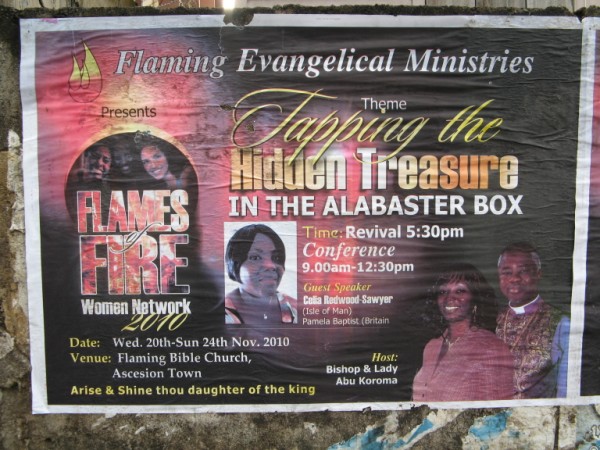
With the closing of the rainy season, nocturnal activity is on the increase once again, in Freetown. It comes in many forms and is very audible and not always melodic. It would appear that the dry season is revival season. Even as dawn breaks, the preachers’ amplified exhortations and alleluias can be heard closing an all night vigil in any one of the many churches and charismatic movements that exist in our neighbourhood. It is unlikely that a recent newspaper article on the subject of “church unity” is an issue for them.

Articles and stories that appear in Salone’s newspaper are habitually picked from the internet and the author’s name and the context from which they are writing never appear. This happens to be the case in the Awoko newspaper’s article “the need for church unity”, so that it is legitimate to ask, whose need, which church and what kind of unity is being referred to and where? The article makes no reference to inter-denominational relationships or ecumenism or mission so that it would be appropriate to ask what kind of church is being envisaged. Besides, it is a question any mission partner, church worker or member should be asking in Salone today.

Our own involvement in ecumenism was nurtured as mission partners with the United Church ofinvariably involved a host of denominations including Anglicans, Lutherans, Roman Catholics, Seventh Day Adventists as well the Presbyterian and Congregationalist who along with Methodists made up the United Church of PNG and Solomon Islands. Ecumenism is never more vibrant than when it is expressed in missional activity, be it by denominations or collaborative agencies.

In our current appointments, ecumenical endeavour lies at the heart of the college’s mission statement. The churches, movements and ministries from which the students are drawn are richly varied in both their histories and theology. However, they are but a segment of what can be seen in Freetown , as a manifestation of Christian based endeavour and purpose.

The library of Westhill College in The University of Birmingham includes a room dedicated to the work of Harold Turner, whose pioneering enquiry into New Religious Movements spanned decades. His work produced a wide ranging examination, which challenged long held assumptions, as to what was and what was not organised Christian religion. We met Harold very briefly when he was researching “cargo cult movements” in PNG and we shared our superficial understanding of the ‘millennium movement’, in our area of the Baining Mountains of East New Britain. Melki, its leader, was a quiet, rather shy man, but possessed a following with Uramat speaking Bainings, which frequently assembled in specific locations often close to burial sites and performed rites and military styled ritualistic acts which created a serious disquiet among local church leaders.

Known popularly as “cargo cults”, because of the anticipation of material wealth, a common feature of all millennium movements, these movements were evident in several locations across the whole of the country. At times the followers of the cargo cults were numbered in their thousands, in Melki’s case, it was but a few hundred, but like all such movements, they anticipated a day of rich material blessings to arrive in a given location and often on a given day. For Melki, the date was undetermined, but the nearby Rabaul harbour was the point at which riches, sent by departed ancestors, were to arrive at.

The transferability of this experience has become evident during our first year in Freetown. Small and mega gatherings, inspired by church and movement leaders from various parts of West Africa, have been a common feature of religious life. They are usual widely publicised with the invitation to allow “your gates to be opened” so that God’s riches may enter or for “an encounter with divine blessings”.

The phenomena of churches mushrooming on the gospel of prosperity are not confined to Salone or even West Africa, they are a universal aspect of the religious landscape in any nation, but they may well flourish better in tropical climates. It was reassuring to find that the link we have begun to make between the Melanesian “cargo cults” and the prosperity churches has been covered recently by eminent academics in sociology of religion, some of it in response to a short film made in Ghana, “Prosperity Gospel, Behind the Scenes”.

It appears that the holy seal of approval of lust, greed, and consumerism is granted by Neo-Pentecostal church leaders, who organise networks, coalitions and movements, to declare prosperity and material wellbeing to individuals, families, with a demonstration of resources that are naturally designed to impress. Even the names of the organisation alone are intriguing , “Church of the End Time Army of God”, “Battle Axe Ministries”, “Winners Chapel” and “Let My Gate be Open”.

As observant students of new religious movements, we went to the national stadium recently, to witness the first of a two night mega event of “empowerment”. A nearly half full stadium was still growing in numbers, vitality and anticipation as we seated ourselves among people at least a generation younger. As with churches across the city, women were in the majority, but the average age was younger than that which we would meet on a Sunday morning and we were greeted by a few people we knew. Responsive and willing to provide loud “alleluias” when prompted, the congregation was also eager to buy the white handkerchiefs bearing the image of the founding Bishop, ready to be waved at appropriate moments. They were also equally willing to wave the 1, 2, 5 and 10,000 Leone notes (2US$) in the air, before depositing them in large plastic bags to be tied tight and hurled over the perimeter fence onto the running track and collected by the uniformed stewards.

Emotional expression was at times exuberant but there were also moments of stillness, deep concentration and quiet reflective singing too. A choir item, led by a group who were surprisingly under-amplified for a congregation of 8,000, provided the entry of The Apostle who arrived in a cavalcade of top of the range 4x4 vehicles and a large squad of military styled “security men”, who positioned themselves across the football pitch. The presence of the Apostle/ Bishop caused one or two women’s legs to give way in a show of euphoria, but it was but a momentary phenomena and which passed without exploitation by the event leader.

In his teaching the Bishop made reference to several mission imperatives, that we could also say alleluia to. Included were poverty reduction, the creation of youth employment as well as the elimination of illiteracy and infant mortality. Frequent reference was made to being empowered to use the solution of faith. It was faith alone that would provide the material betterment to eliminate societal sickness.

When staying with Fr Pat Rasmussin, in December 1972, we discussed at length the impact of the cargo cult that had recently centred on Mt Turu, which lay within his area of work and service, in The East Sepik Province. The movement was made up of some 30,000 people, some of whom had abandoned subsistence farming in anticipation of the wealth that would emanate from the removal of a concrete obelisk, a trigo-metrical point on the summit of Mount Turu. The offending object was uprooted and the people duly returned to their villages and the anticipated social unrest from unfulfilled expectation did not arise.

The application of logical thinking, associated with the principles of the enlightenment, was considered to be of no assistance in trying to comprehend this particular millennium movement. And perhaps, despite all the automotive hardware of 21st century engineering and the electronics of the public address systems, the application of cause and effect, to decipher the workings of prosperity gospel fuelled churches may also be unfruitful. The replication of neo-pentecostal practices , especially in worship, is, in our experience, progressing at an alarming rate into the synodical and historical churches. Could the absence of a rational understanding of the prosperity gospel phenomena be the reason for an ambivalent attitude of the church unity organisations ie Sierra Leone Christian Council and The Evangelical Fellowship of Sierra Leone, to comment on the effect these movements are having on their member churches? Or is their silence an endorsement of the influence of the phenomena on their member churches?

Thursday, November 4, 2010

Pre Nuptials, Marriage and Procreation

We have been seeing far too much of the petrol pump of late, as we have gone a week without national electricity and needed to resort to frequent use of a small generator. Systems of public safety are not overly visible in Salone, so it was instructive to be told to wait a few minutes on the forecourt of the filling station, as a delivery of fuel was being taken from a tanker. One of the male attendants indicated to his female colleague that Peter was wearing a ring on the third finger of his left hand. This led to a discussion that began with the young woman insisting that a Salonean marriage only involved the exchange of cola nuts and not rings. This progressed as to why Peter’s wedding ring (like Janice’s) is silver and not gold. In the mid 1970s neither of us were keen to support South Africa’s Apartheid gold industry and opted for more ethically acceptable soft silver. The original designs were created using “silver” chewing gum paper and the actual rings were made by colleague friend at Middlesbrough College of Art.

That same day, we read an article in the British press indicating that the UK’s reputation as the divorce capital of Europe was under threat. This arose from the high court ruling on Katrin Radmacher and her French ex-husband, Nicolas Granatino, 38, a former investment banker, who had signed a prenuptial agreement before their wedding in London in 1998, in which it had been stipulated that neither party would benefit financially if the marriage ended. By a majority of eight to one, the supreme court justices dismissed Granatino's appeal, saying that after their ruling "it will be natural to infer that parties entering into agreements will intend that effect be given to them".

Marriage, and the ending of it contrasted with the invitation we were given to witness a Krio engagement ceremony the following Sunday evening in the home of one of our students, a short distance away, in Wilberforce village.

Our awareness of this rite of passage had begun in our Krio classes in the first half of this year and in addition to studying how the language operates, we were looking at some of the cultural and traditional practices of the Krios.

Sierra Leonean Krios are an ethnic group whose history dates back to the time of the trans Atlantic slavery. Their ancestors had been captured and shipped to the Americas or Europe as slaves, and following the abolition of the trans Atlantic slave trade in 1804, and a result of slaves having fought for America during its civil war, a number of them were granted their freedom, and to cut a long story short, with great difficulty returned to West Africa. The ancestors of the new arrivals could have come from any of dozens of West African countries where slaves had been taken from. Established as a colony to those given their freedom, Freetown and the Krio language, traditions and customs of those freed, developed and drew upon a variety of West African practices, particularly the Yoruba of Nigeria. Other influences include the practices, belief and rituals of Christianity that had been experienced and appropriated on the other side of the Atlantic.

One such custom that is still practised among Krios today is that of the announcement of an engagement prior to marriage, which takes place in the home of the bride to be. Our invitation to such an event came from Ronald, a student at College, as we were giving him a lift home one night. We eagerly accepted. Having heard the theory, in our Krio classes, now we could now see the experience the ritual.

The Dunbar family live in Wilberforce, a large, well established community, set up on high ground by wealthy Krios, and which features a recently installed statue of William Wilberforce. We arrived just before 7pm, and were introduced to Mr Conteh the spokesperson for the Dunbar family, who was sitting close to the door. A number of friends and relatives of the family were already seated in what is commonly referred to as the parlour.

Soon after 7pm there was a knock at the door. Mr Conteh responded, but did not open the door. A long conversation took place with those outside. Mr Conteh interrogated the people outside. “Why they had come, why and should they be allowed to come into the home?” Represented by an emissary, they had come to find a young woman who had been seen looking out from the veranda of the house, and they had a special message to give to her. Further questions were asked, through the door, about this event, and eventually the spokesperson felt sufficiently confident to let the people in.

There was a delegation of some 12 or more people, all with the intent of meeting the young woman, but only the emissary spoke. Dressed in an elaborate West African outfit, he traded dry, humorous exchanges as to whether there was such a young woman in the house, who had been spotted, as she looked out over the veranda. Eventually one woman was brought out from an adjoining room. No, she was certainly not the person who had been seen. After further questioning, a second young woman was presented. Aged about 2 years old, she was obviously far too young to have been looking over the veranda. Another attractive young woman came out, and much was made of her beauty, contours and breasts all of which invited admiration. The reply was polite and simple “all that all that glitters is not gold” as they were not identical to the shape of the woman seen on the veranda. Doubt was beginning to set in. Had the messenger made a mistake, was he at the right house? He was adamant. Surely there was another room that had women in it? The spokesman said that there was and he would go and make enquiries. After a while he came back, with a young woman who had looked out of one of the windows of the house. She was greeted with eagerness and respect, and yes, she did have lovely curves and beautiful facial features, but she had been looking out of the window and not over the veranda. So back she went.

While all this was going on, a sudden storm of wind and rain had got up, which caused a power cut. The family had a generator, which was started up on numerous occasions, but was not able to keep going. So it was necessary to resort to candles. To assist the inspection of the young women, torches on mobile phones came into play, to make sure that the right person was found.

After further wait, another young woman was brought out and presented. Immediately there was recognition, that she had been the one looking over the veranda. Then the discussion started as to why the messenger was so eager to find this woman. He had come to request her hand in marriage for a family member, and as a sign of the intention, had brought gifts for the family.

A calabash covered in a white cloth, was presented to the bride, which had kola nuts, (to cement the friendship, solidarity and generosity between the two families), needle and thread, (encouragement for the bride to be a good seamstress), bible, (for faith, prayer and Christianity), and a ring (symbol of the betrothal). Also in the calabash were envelopes with money inside, which were given to the bride’s parents, family members, and important supporters such as the local minister or pastor.

Then the messenger indicated that he had other more valuable gifts, non alcoholic whisky – With Honour I Seek to Kiss you/ Watch How I Sincerely Kiss You; that there would be a trip to Italy – I Truly Adore and Love You, and Holland was to be another destination– Hope Our Love Lasts And Never Dies.

The bride-to-be was called Ronty , from the names of her parents, Ronald and Betty. After the ring was placed on her finger, she proudly went round the room, to show her ring to everyone who eagerly waited to see it.

Up until this point in the proceedings the groom had not appeared, and wouldn’t for quite some time. His father, Mr Roby spoke of how Ronty would be welcomed into their family, and acknowledged the importance of both families being followers of Christian beliefs and practices. He then expressed his joy by breaking out into a chorus, which was received with much appreciation.

The time had come for light refreshments, which initially were pieces of cake and locally brewed ginger beer, but this was quickly followed with plates of bulgar wheat, kebabs, fish balls, and bread and butter, with a choice of “colas” or beers.

We chatted to the young man sitting to the right of Janice, to discover that he was a friend of the groom, William Charles and that through text messages he was keeping him informed of what was happening, but Ronty said that it was too early for him to come in. We discussed whether a similar tradition was kept by other ethnic groups such as the Mendes or Tembes, and were told that their practices and rituals differed, but for both groups, one essential requirement was as to whether the potential bride could satisfy the man’s sexual needs. We tried to ascertain whether proof of fertility would be necessary before marriage, and this could be so. The young man was called away by William but each time he returned kept us up to date as to what was happening.

Once people had eaten, they started to depart and eventually William appeared. Ronald introduced us to him, and for us it was then time to withdraw. The account that our Krio teacher had given had been replicated, and we felt honoured to have been witnesses to the drama. Unfortunately we will not be in Freetown on the day of the wedding. What a pity!

(Names have been altered and the "happy couple" have requested that their photos are not included.)